

Removable Partial Dentures
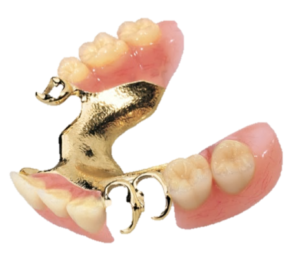
- A removable partial denture is an economical way to replace one or multiple missing teeth in the front, back or both with a prosthesis that uses the teeth and gingiva for support. The prosthesis is removed at night and for cleaning.
- The missing teeth can be on the front, back, or both
- This is typically an economical way to replace multiple missing teeth
- There are several types of removable partial dentures ranging from:
- Traditional prosthesis with metal clasps
- Prosthesis that have precision or custom made attachments to enhance esthetics and remove clasps
- Implant assisted partial dentures
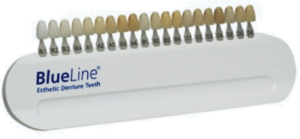
- At KC Complete Prosthodontics we use premium teeth from Ivoclar Vivadent Blueline and Phonares lines of teeth, which allows us to offer 60 molds of front teeth in 20 shades to meet each individual patients esthetics needs.
Complete Dentures
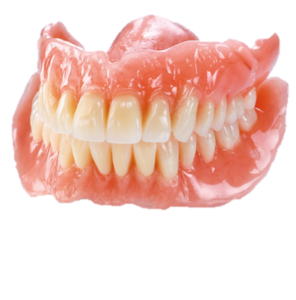
- Complete dentures are the traditional method for replacing teeth when the patient has no teeth. While not exactly replicating someone’s natural teeth, dentures allow for better function and esthetics than broken down or no teeth at all.
- Denture teeth are like natural teeth with many varying shapes and sizes. Here at KC Complete Prosthodontics we use premium teeth from Ivoclar Vivadent Blueline and Phonares lines, which allows us to offer 60 molds of front teeth in 20 shades to meet each individual patients esthetics needs. We also offer multiple occlusal (bite) schemes to give your dentures the best chance at success during functioning (chewing). We have actual molds of the teeth for you to look at prior to your selection.
Come in today to actually see the teeth that will be in your denture

- One of the most important aspects of the denture is the impression (the mold of your mouth). If the impression is poor, the fit of the denture will be as well. At KC Complete Prosthodontics, all aspects of your denture impression will be custom to your mouth with the most accurate material. The extra step of multiple impressions are what makes the fit of the denture better.

- The KC Complete Prosthodontic Advantage
- We offer an extensive selection of tooth shapes and colors to fit you
- Impressions are made with a two step impression process utilizing custom trays that fit only you and extensive molding to make it fit of your denture excellent
- We utilize an extra step between the impression and try in of teeth to help ensure a correct bite and positioning of teeth
- Come in today and see the difference that the extra steps we use makes a difference in how your denture fits – DON’T HAVE THIS BULLETED BUT AT THE BOTTOM GOING ACROSS AND BIGGER (Don’t type the caps stuff just wanted to say how it was formatted)
Overdentures (Implant Retained Dentures)
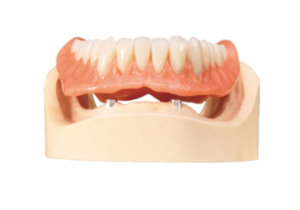
- An overdenture is a complete denture that has a number of implants usually 2, 4, or 6 that are used to stabilized and hold a denture in place.
- The denture has a snapping mechanism that allows the denture to be removed, but gives the patient confidence that the denture will stay in place, help with chewing, and feel more like natural teeth.
- This treatment is the next step up from traditional complete dentures to feel closer to your natural teeth
Advantages of the Overdenture:
- Feels and functions more like natural teeth
- Increased stability and function during chewing
- Implants will help prevent bone loss
- In some cases, the palate can be removed to allow better taste and temperature perception
- More confidence
- Easy to clean
- Less costly than fixed dentures with many of the same benefits
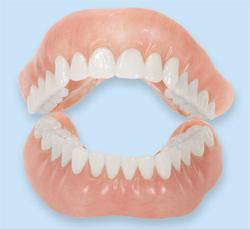
Fixed Denture (Implant Supported) aka The All-on- Four
- Fixed complete dentures use implants (4 or 6) to hold the denture in place and feel like natural teeth.
- Unlike their removable counterparts, fixed dentures feel and function like natural teeth.
- The amount of material in the mouth is greatly reduced leading to more comfort.
- The materials range from traditional acrylic to porcelain like crown and bridge for enhanced esthetics.
- If a temporary fixed denture is desired, this can be accomplished after the extraction and implant placement
Immediate Dentures

For some patients there becomes a time when the difficult decision to move from natural teeth to a prosthetic solution is necessary. This can be due to periodtonal (gum) disease, missing teeth, broken teeth, poor esthetics, or a combination of the above. One of the most common questions patients have is will I have teeth during healing ? The immediate denture is a temporary denture that is placed immediately after surgery that is used during the healing period. During the healing period, soft liners are placed (soft material placed inside the denture) to tighten the fit and cushion your bite until the healing is complete.
- The immediate denture helps with:
- Swelling
- Esthetics
- Function
- Confidence
- Once the healing is complete, a new denture is made that allows for changes in esthetics, occlusal (bite) scheme, and a brand new denture base
- An immediate denture can be combined with implants to have a fixed temporary denture until the healing of the implants is complete (see all on four section)
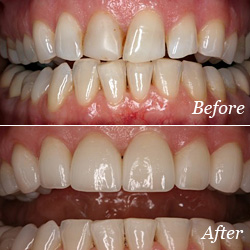
The all-on-four (Nobel Biocare)
- This is a specific protocol that uses a specific placement of implants after extractions to allow an immediate prosthesis to be placed that is fixed in place during the healing period.
- After the healing process is complete, a new prosthesis is made that has a metal bar connecting the implants together helping to stabilize the implants and prosthesis
- This process is completed with the help of a surgical specialist (Periodontist or Oral Surgeon) and the Prosthodontist (restorative specialist)
- The benefits of this treatment protocol
- You teeth are always fixed in your mouth
- The teeth feel more like natural teeth
- The prosthesis is more comfortable than removable prosthesis
- Improved confidence
- Don’t feel your teeth will fall out when you laugh or eat
- Better chewing ability (once healed)
- Potentially no bone grafting
- Convenience: Less denture adjustment visits
- No denture adhesive
- No palate on the upper denture which allows the temperature of food to be felt and increased taste
Crowns
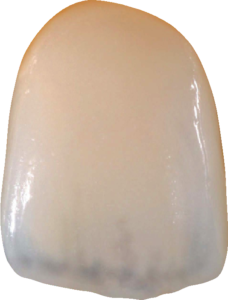
Courtesy of Ivoclar Vivadent
The purpose of a crown is to strengthen a structurally weakened tooth and prevent further breakdown.
- Indications for a crown include one more of the following:
- A cracked tooth
- A broken tooth missing tooth structure
- A large filling increases the chance of fracture
- A large cavity increases the chance of fracture
- The occlusion (bite) needs alteration
- Improve esthetics
- Protect a tooth with a root canal from breaking: Posterior (back) teeth are lost 6x faster without a crown after root canal treatment.
- A combination of these reasons
The crown process is a 2 step process
- The first appointment
- The patient is numbed
- Decay is removed and missing tooth structure is replaced with build up material
- The tooth is prepared
- An impression (mold) is made of the prepared tooth
- A temporary crown is fabricated
- The second appointment
- The crown is checked for:
- Color and shape
- Contact between adjacent teeth is present and allows floss to pass with ease
- The bite is adjusted to feel correct
- The crown is cemented in place
- We offer multiple types of crowns depending on the patients needs
- IPS e.max
- Zirconia
- Porcelain Fused to metal
- Gold
- The crown is checked for:
Bridges (Fixed Partial Dentures)
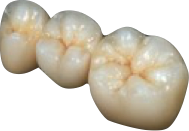
A Bridge is used when a missing tooth is to be replaced to enhance esthetics and function. The bridge is similar to a crown but uses two or more prepared teeth to replace a missing tooth or teeth. When other options are not possible or desired this method can be used to replace a missing tooth
- The bridge process is a 2 step process
- The first appointment
- The patient is numbed
- Decay is removed and missing tooth structure is replaced with build up material (if needed)
- The teeth are prepared
- An impression (mold) is made of the prepared teeth
- A temporary bridge is fabricated
- The second appointment
- The bridge is checked for:
- Color and shape are correct
- Contacts between teeth are present and allow floss to pass
- The bite is adjusted to feel correct
- The crown is cemented in place
- The bridge is checked for:
- The first appointment
- We offer multiple types of bridges depending on the patients needs
- IPS e.max
- Zirconia
- Porcelain Fused to metal
- Gold
Veneers
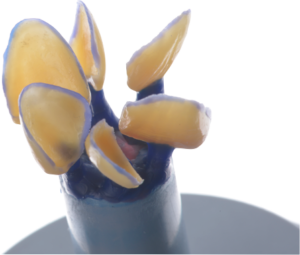
A veneer is a thin piece porcelain (tooth colored material) that is placed on the outside surface of a tooth. The purpose of a veneer is to enhance the esthetics of ones smile to increase confidence and visual appeal. The indication for a veneer is structurally sound teeth desiring esthetic enhancement. Veneers are designed to be less invasive than crowns and can be minimal or no-prep depending on the situation. They are not designed to replace considerable missing tooth structure.
- Indications for veneers
- Discolored teeth
- Ill-shaped teeth
- Diastemas (gaps between teeth)
- Poor esthetics
- The veneer process is a two step process:
- The first appointment
- The tooth is prepared
- An impression (mold) is made of the prepared tooth
- A temporary veneer is fabricated
- The first appointment
- The second appointment
- The veneer is checked for
- Color and shape
- Contacts between teeth are present and allow floss to pass easily
- The bite is adjusted to feel correct
- The veneer is bonded in place
- The veneer is checked for
Fillings
When teeth have been minimally affected by cavities, fracture, or discoloration they can be restored with a filling. The filling can be tooth colored or silver depending on each patient’s needs and desires.
Extractions
In some cases, there is nothing that can be done to retain a tooth and it must be removed. Tooth removal can range from simple extractions, to teeth broken down at the gingiva, and other complex extractions.
Occlusal Guard
An occlusal guard is a piece of acrylic (plastic) that separates the teeth and is the substance that is worn so your teeth are not. These are specifically fitted for each patient and their bite.
Indications for occlusal guards are:
- People who grind or clench their teeth
- To protect restorations that are placed
- Treat temporomandibular disorders
When someone has a tendency to grind their teeth at night, this can be a very destructive process that can lead to significant negative consequences for the dentition including shortening of teeth, fracture of teeth, promoting shifting of teeth, and poor esthetics among others.
Obturators
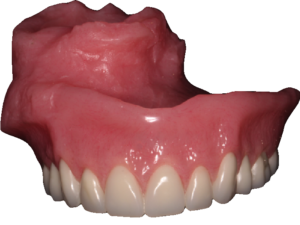
- When faced with oral cancer, sometimes the patient must have part of the oral cavity removed to treat the affected area, thus leaving a surgical wound/opening. When this happens, an oral prosthetic device can be fabricated to fill the surgical site/opening in an attempt to restore function whether that be swallowing, prevention of fluid transfer, or speech. Due to the complexity of oral cancer treatment, we will coordinate with other specialists to facilitate treatment.
- When this happens, an oral prosthetic device can be fabricated to fill the surgical site/opening in an attempt to restore function whether that be swallowing, prevention of fluid transfer, or speech.
- Due to the side effects of oral cancer treatment including radiation, Dr Sparks will help coordinate with the other specialists who have treated the patient to coordinate oral rehabilitation.
Implants
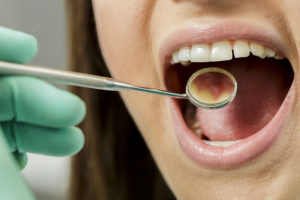
Dental implants are traditionally made from titanium and mimic the root of a natural tooth to aid in the replacement of teeth. Implants can be used in multiple modalities in oral rehabilitation including single/multi tooth restorations, retaining overdentures, and supporting fixed dentures.
- Prevent bone loss
- Allow restorations to better mimic real teeth
- Prevent adjacent teeth from being affected to restore a missing tooth
- Provide a fixed restoration rather than a removable one
- Make removable restorations more like fixed ones
- Improved quality of life
- Increased confidenceThe advantages of implants include:
As stated in our philosophy, we believe in teamwork and in some instances we feel to give you the best results, you may need to have someone else place the implant for us to restore. In this situation, we have referrals to other specialists to have them aid in your successful restoration.
Come in today to discuss your implant treatment and see how a team of specialists can make your implant restoration a success.
At KC Complete Prosthodontics we place select implants depending on each individual case. Dr Sparks has extensive training and experience both placing and restoring implants and is happy to discuss your treatment needs with you.